Showing posts with label sightseeing. Show all posts

Wednesday, July 30, 2008

Back at Cairo

Our last couple days were back at Cairo. One of our lectures was at the Arab League. (Think the Arab version of the UN.) It was pretty impressive touring the facilities.


However, during the lecture it was hard not to say "I'm sorry" on how our current administration has ignored everything the Arab League has suggested in terms of international policy. That being said, the issue of Radical Islamic Terrorism never came up. I guess both sides have some faults - with no easy solutions.

One of the highlights for our last couple of days in Cairo was going to a concert. A week prior I had ventured out to the Zamalek neighborhood. (That's were the Islamic Ceramic Museum was. A museum that has no gift shop, nor do they allow photography inside. Do these people not know how frustrating this is for me?!?) As I was wondering around, I found a fabulous bookstore, Diwan - like a little Egyptian Barnes and Noble. (Me finding a bookstore - there's a surprise! Ha!) Being in an adventurous mod, I bought a CD by Fathy Salama. (Check out his My Space page.)Low and behold he was having a concert at the Outdoor Theater of the Cairo Opera House.


In a great example of the contradictions of Egypt, his band consisted of a man wearing the traditional turban and galabeya playing the finger cymbals, along side the bass player with this "Iron Maiden" tee-shirt. I never thought I would say, "Wow, that accordion solo was amazing!" but it was. He had a fabulous singer from Algeria, Karima Nayt. (Her CD is coming out in September, you heard it here first.)

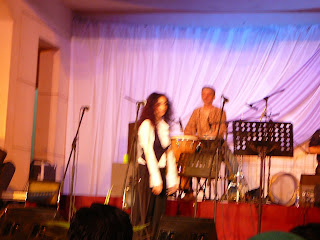


Allison and I were tickled to met him after the show. Such a great musician, and he was so nice. He wanted us to come see his show in Alexandria, or again in Cairo in August. Sadly, we're leaving on Thursday.

Saturday, July 26, 2008

Alexandria

After two nights in Cairo, we were back on the road to Alexandria. The highlights of Alexandria for me were the Biblioteca Alexandrina and the roof-top bar at the Four Seasons which was one block away from our hotel. (The Greco-Roman Museum was closed.)

First, the Biblioteca Alexandrina. This new institution is basing itself on the ancient library in Alexandria, often dubbed at the birthplace of Western academia. (I highly encourage you to check out their website, I couldn’t possibly cover all of their research centers and support. Their Eternal Egypt site is awsome.) The architecture was well-thought out. There was text from every language on the outside.


The inside was filled with natural indirect light.

They have a children’s library (which is pretty rare in Egypt), a manuscript collection, an internet archive (first one outside of the US), a couple of museums, a Planetarium and this really cool interactive program. They have nine (!!) projectors synched with each other to create one huge panoramic screen. With a pretty cool remote, you can navigate though a computer system on Egypt – past and present. For example, you can pull up a panoramic view of the Temple of Ramses II, with various links on the Aswan Dam, the history of Ramses II, how it was constructed, etc. (Being a group of teachers, we all wanted one in our classroom!)

While we did some sightseeing in Alexandria, the second highlight for me was the Four Seasons. Their bar, Blue, was outside over looking the Mediterranean; a perfect spot to watch the sun set.

Especially when drinking a Strawberry Tequila Mojito:

Maybe the seven-week mark was harder than I imaged, but I really loved hanging out in this bar, and I had some company. (Ok, I will admit that is me on the far right, looking the other way. I honestly didn’t think I was in the shot, and I was watching the sun set.)

My friend Kathy got this shot from the bar – amazing!

Wednesday, July 23, 2008

Aswan and Abu Simbel

Going further down the Nile, we stopped at Temple of Edfu, one of the largest ancient Egyptian temples in existence.

The Temple of Edfu, like many other ancient temples, had a Nilometer. The ancient Egyptians used a Nilometer to measure the level of the Nile, and collect taxes. If the Nile was exceptionally high (flood-stage) or low (drought) then the taxes were reduced, since the farmers were suffering from ill-conditions. Conversely, if the Nile was flowing at an optimum level, the higher taxes were levied.

There are some local legends in which if a woman is scared in a Nilometer, she will become pregnant. Our guide Selma noted that is was rare to see locals in these temples, but what did we see coming out of the Nilometer:
An older women and (presumably) her daughter.

Later that day we had a felucca ride on the Nile. This is what a felucca looks like:

Quickly into the ride, a row boat with two young boys came along side ours. Just like Christmas carolers, they sang songs, hoping for a tip.

Then our crew provided the entertainment with Nubian songs:

Our cruise docked at Aswan, home of several ancient temples Temple of Kom Ombo, and Temple of Philae. Now, as much as I love ancient Egyptian temples, they were starting to look the same. “Oh look, a huge column covered with hieroglyphs.” “Hey, another image a Horus.” Many of us were suffering from temple burn out. On interesting aspect to find how the later Christians changed the site, or old graffiti.

But even with the temple burn-out, what did many of us do? Take the optional flight down to Abu Simbel to see yet another temple. The half-hour flight saved several hours of driving through the barren desert. When tour buses do make the trek, they go caravan style, just in case one breaks down. There are no services between Aswan and Abu Simbel, if a bus breaks down, it is abandoned and everyone gets on to the other tour buses. Waiting for a tow truck could be deadly, due to the heat.

With Aswan having a rather small airport, we were pretty surprised to see this:

Yes, that is a Sbarro’s in the Aswan Airport. This spread of Western fast-food never ceases to amaze me.

Abu Simbel is south of the Tropic of Cancer, the furthest south I had ever been. Ramses II, being such a modest guy, built his most impressive temple down here to intimidate the Nubians, and anyone else coming down the Nile.

While the temple is large and certainly impressive, the “wow” factor for me is that temple was moved in the 1960’s. When the Egyptians constructed the Aswan High Damn, they calculated that this temple would be submerged. So the entire temple, inside and out, was disassembled and placed in a man-made mountain on higher ground.

Surprisingly, it was not unbearably hot at Abu Simbel, as there was a nice breeze coming over Lake Nasser. (Read: It only felt like it was 102F, instead of 120F.)

Our return flight brought us back to Aswan around noon. We spent the afternoon on the boat, before heading back to Cairo on the overnight train. Plane, boat and a train in one day. Is it any wonder that several of us (myself included) felt an odd sensation like we were still “moving” the next day in Cairo?

Tuesday, July 22, 2008

Temple Tour, Part Two

The next day we left early for the Valley of Kings, where generations of pharaohs were buried. Sadly you can take photos outsides of the tombs, but not the interior.

After the Valley of Kings, we went to the Temple of Hapshepsut. When looking at the temple you have to image it originally being covered with bright sculptures and lush plants.

While the tour was fun, it was unbearably hot. Sweat was running down into my eyes. We returned to the cruise ship and began to cruise down the Nile. (No, that is not our cruise ship!)

As luck would have it, two days prior to leaving Luxor, Arlene, a fellow traveler, gave me the book, Down the Nile by Rosemary Mahoney, as she had just finished it. Mahoney wrote about her experience rowing down the Nile, something virtually unheard of in Egypt. Though our trip was opposite of hers, (She started in Aswan, and followed the river flowing northward, we went up the river.) it was incredible to follow her story as we were surrounded by the beauty of the Nile. While I did not have the same experience that she had in Luxor, I certainly agreed with many of her observations of Egyptian life.

Monday, July 21, 2008

Upper Egypt, Part One

Yesterday morning, we returned from our trip to Luxor, Aswan and Abu Simel. This section of Egypt is known as “Upper Egypt” even though it is Southern Egypt. As the Nile flows northward to the Mediterranean Sea, “upper” refers to “up the river.”

Our first stop was Luxor, via overnight train from Cairo. This, along with so many aspects of our trip, turned out to be a cultural experience. The overnight train consisted of cabins (Here with my roommate, Peggy):


And dinner: (Umm… not the best I’ve had.)

A beer I can not recommend:

And a club car:

(I didn’t hang around too long here, pricey drinks and too smoky.)

The porters then came around to pull out the beds:

Our tour guide, Selma, said that only tourists took this train. We weren’t sure if this was due to security or financial reasons. (With Egypt Air flying to Luxor and Aswan from Cairo, maybe the issue was time.) For the most part the train followed the Nile and/or one of the drainage canals parallel with it.

Normally I can sleep anywhere - planes, trains and automobiles. This ride was a bit rough; the train kept jerking and stopping.

Arrive at Luxor, we boarded our cruise ship. The ship, The MS Nile Odyssey, was part of a large fleet; very British in every way. There was tea time at 5pm, four course, sit-down dinner at 8pm. Lunch was a large buffet. As lovely as the food was, when it’s reaching 40C, I really didn’t feel like have stuffed duck, mashed potatoes and gravy for lunch. There were some salads, but with my recovering stomach, I really didn’t want to chance raw veggies.

With the sweltering heat, we toured the sites either very early in the morning, or late in the afternoon. Our first temple was Karnak.

With these ancient temples, you soon find how inadequate the English language can be in conveying size and scale. “Big” just doesn’t cut it. “Enormous” comes close, but still does not capture the height, as it is subjective.
We then went on to Luxor Temple:


This ancient Egyptian temple was buried under sand for over a thousand years. Where part of the temple was sticking out, the Egyptians built a mosque, which is still there and in use. (The tourist below are in the ancient section that was buried.)

Thursday, July 10, 2008

El Arish

El Arish is in the Northern Sinai, not far from the border with Israel. When Europeans come to vacation in Egypt, they go to Sharm el Sheikh. They have the Hilton and the Sheraton, high end resorts and lots of restaurants. El Arish is where Egyptians go for vacation. The hotels are not as plush, the restaurants are much smaller in number. There is the Mediterranean Sea.

But you have to watch out for the jellyfish. (A couple people in our group were stung, nothing life threatening, just painful.)

The major draw for us to go to El Arish was the Bedouin Market. Several of the speakers we’ve had compared the Bedouin to the Native Americans in the US. They are a separate society from mainstream Egypt. Most people identify Bedouin women as being covered in black with decorative veils.

The market was overwhelming. The Khan el Khalil Bazaar seemed calm compared to this. There were many more locals; in fact I would venture to say that we were the only tourists in the whole market. It was very frustrating that many women either hide their veiled faces or shook their fingers “no” as soon as they saw my camera. Some people did pose for a photo. This mother was proud to show off her beautiful baby.


This man tried to sell me a goat.

Here’s the sheep and goat market.

This was the equivelent of a lemonade stand. You could use the glasses there, or for the "to go" option, he would put the drink in a small plastic bag and twist it around a straw.


The stall for spices and grains.

This little girl was very happy to pose for me.

This woman was carrying a huge head of cabbage on her head.


This Bedouin woman allowed me to take a photo, but notice how she's not looking at me.


After the market, we went to Mari Culture Research Center. We met the director and founder of the school, Dr. Samir Ghoneim. He told us that his vision of the school was to help the people flourish in the Northern Sinai. He did not believe in specialization, rather wanted to give the student skills to survive and live off of the land. Instead of specializing in micro-biology or chemistry, students learn just enough to be useful in their daily lives; such as being able to test their well water. He brought together faculty to work on land management, irrigation, bee-keeping, etc. His school works on developing plants that can withstand high sodium in their irrigation. (The well-water here is high in salt, and they are hoping that one day they can develop crops that can be irrigated with sea-water.)

This man didn’t just build a school; he wanted it to be self-sustaining and part of the community. There is a bee-keeping section, to extract honey and provide hives for the farmers for a reasonable fee. They have an olive oil press; they provide help to Bedouin farmers (either free or low-cost).

I will admit after spending time with someone who was so driven to help the economy and production of his community, my profession seemed pretty silly. “Let’s see, you help farmers and the community to survive in the desert, I study and teach about old stuff.”